Specimen A — the flat face Plane. Lacquer. Reads “stop sliding” to the eye. On the throw screen this face is yang: not holy, not unlucky, just flat.
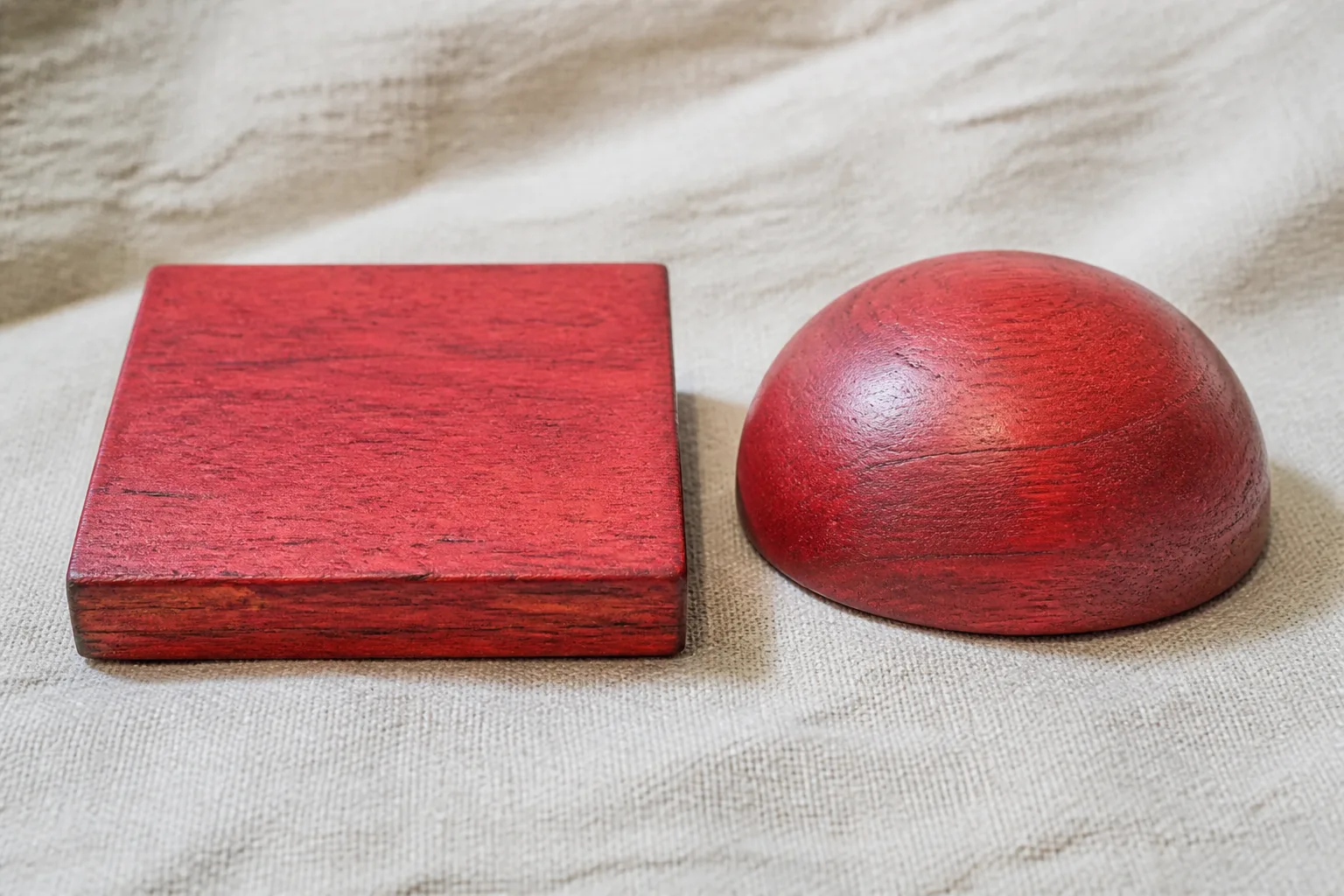
Specimen B — the rounded face Convex. Catches light like a small drum. Reads “rolled” to the hand. This face is yin: not dark magic, just round.
Color is a costume party. Shape is the ID check.
Entry 01 — Stop reading luck from red
Red is pretty. Red is also the color of stop signs, ripe fruit, and theater curtains. If you stare at red long enough, every throw looks emotional. Look at edge instead: does the top line lie level, or does it bow?
Entry 02 — One block, two truths
A single block cannot show flat and round at once. That is why one coin feels simpler and one pair feels richer. The pair adds a third reading when both faces agree: both flat (unclear), both round (not now), one each (go in the game).
Entry 03 — Skins sit on round only
If your site paints small animals, keep them on the curved face. Not because the flat face is snobbish. Because the flat face is the label. Labels should stay readable. A fox on the flat side would turn every throw into fan fiction.
Entry 04 — Practice without mystique
Lay the pair on a table. Tap one block so flat looks up. Tap again. Name what you see out loud: flat, round, flat, round. When you can name it without whispering, the animated throw on your phone becomes a mirror, not a thunderstorm.
Entertainment only. Not advice. Field notes are for noticing, not obeying.